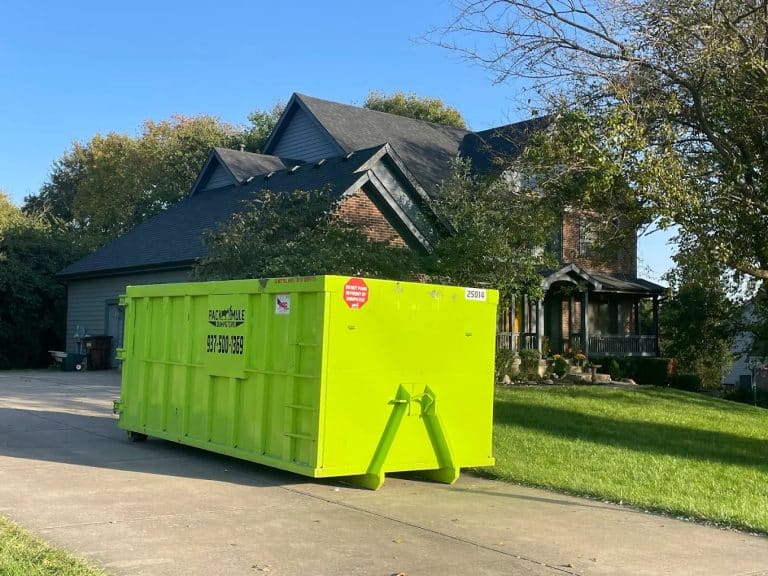


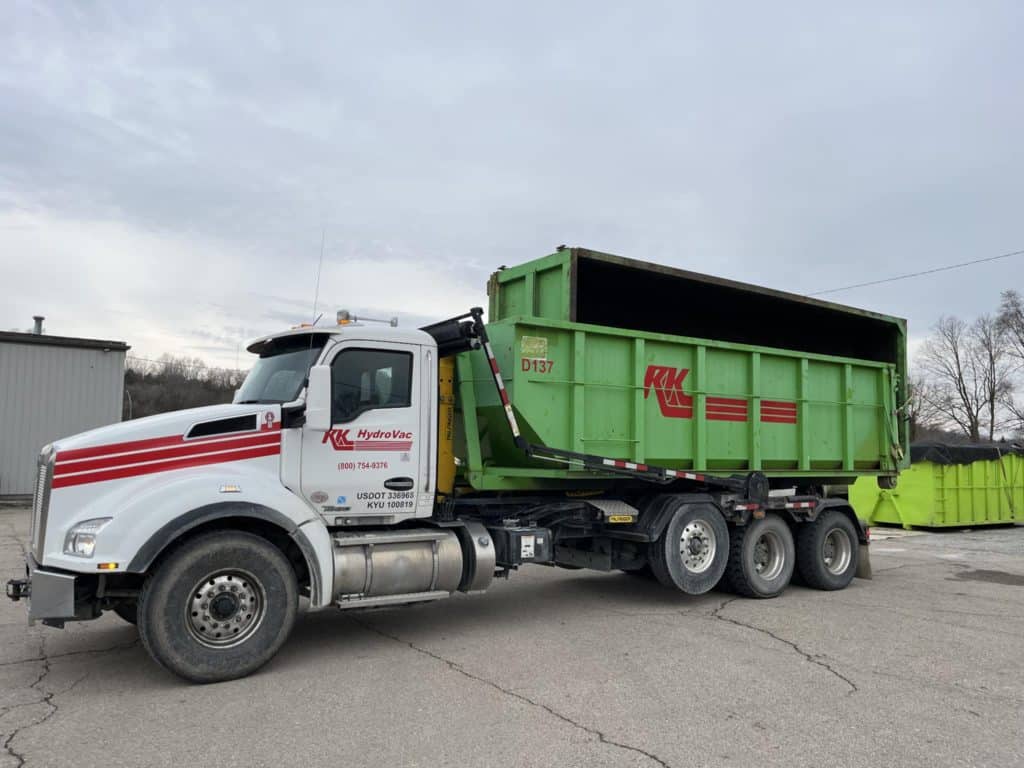
- Quick Answer (TL;DR)
Roof shingle weight varies by product. Published examples show why there is no single number: GAF Royal Sovereign 3-tab shingles are listed at 62 pounds per bundle with three bundles covering one roofing square, or about 186 pounds per square. Owens Corning Duration architectural shingles are listed around 68 pounds per bundle and three bundles per square, or about 204 pounds per square. Some heavier designer products weigh considerably more; Owens Corning lists Woodmoor shingles at a nominal 465 pounds per square. A roofing square equals 100 square feet.
That is why roof size alone should never determine the dumpster. The shingle product, number of existing layers, underlayment, flashing, nails, damaged decking, and other tear-off material all affect the final load.
Planning a roof tear-off in Southwest Ohio? Pack Mule Dumpsters can help you match the roofing load to the right container before the first shingle comes off.
Roofing Debris Gets Heavy Faster Than It Looks
A roof can look manageable from the ground.
Thirty squares. One house. One tear-off.
Then removal begins.
Bundles of shingles become layer after layer of dense asphalt waste. Underlayment comes off. Ridge caps are removed. Flashing gets pulled. Sections of deteriorated roof decking may have to go, too.
Suddenly, the issue is not whether the debris physically fits inside the container. It is how much all of it weighs.
Pack Mule notes that shingles, underlayment, decking, and nails create a dense roofing load, and its roofing guidance estimates that a 30-square roof with two shingle layers can produce roughly 15,000–20,000 pounds of total debris.
That makes roofing different from a typical household cleanout. A container filled with furniture and boxes may run out of cubic space first. With a roof tear-off, weight can become the bigger concern.
“Roofing debris is heavy, and volume alone does not tell the whole story. Estimating the shingle weight, number of layers, and total tear-off debris before ordering can help you choose a dumpster that is properly sized for the job.”
- — Todd Atkinson
Why Shingle Weight Is Not One Universal Number
Questions like “How much does a bundle of shingles weigh?” sound as though they should have one answer.
They do not.
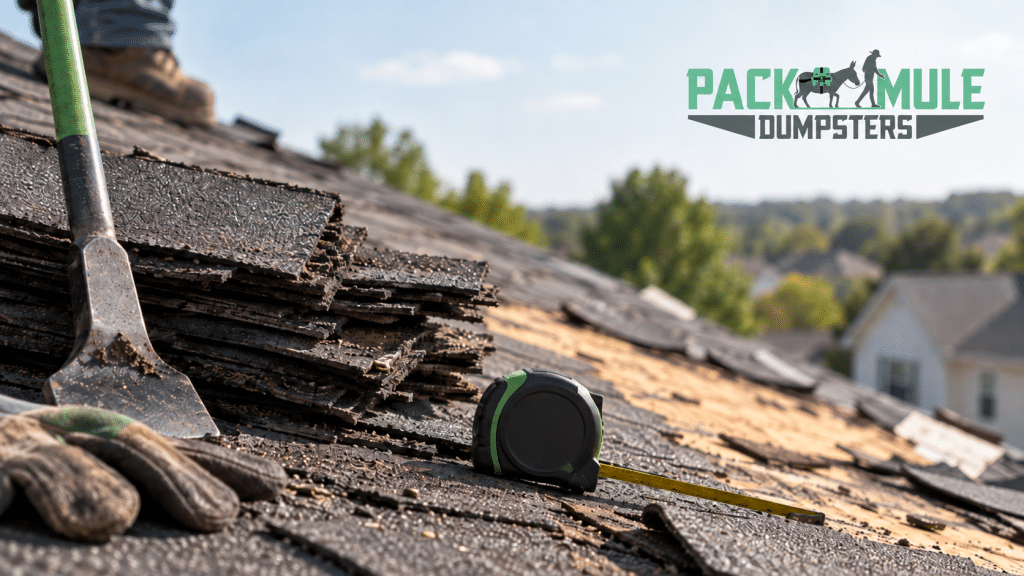
Shingle construction varies considerably between manufacturers and product lines. A current GAF Royal Sovereign 3-tab listing shows a 62-pound bundle, while a current Owens Corning Duration architectural product listing shows 68 pounds per bundle. Premium products can be substantially heavier; Owens Corning lists its Woodmoor designer shingles at 465 pounds per 100-square-foot roofing square.
Roofing example | Published weight | Approximate weight per square |
GAF Royal Sovereign 3-tab | 62 lb. per bundle | 186 lb. |
Owens Corning Duration architectural | 68 lb. per bundle | 204 lb. |
Owens Corning Woodmoor designer | — | 465 lb. |
These examples are useful for perspective, not as universal conversion factors. GAF itself notes that the weight of some products can vary depending on the manufacturing plant, which is another reason to use the actual product specifications whenever they are available.
One Layer vs. Two Layers Changes the Calculation Fast
Once you know the approximate weight per roofing square, the basic calculation becomes easier:
Roofing squares × weight per square × number of layers = estimated shingle weight
Suppose an existing roof has 30 squares.
Using a 200-pound-per-square planning estimate, one layer would produce about 6,000 pounds of shingles. Two layers would put the shingle portion around 12,000 pounds before accounting for other tear-off materials.
But that number should remain an estimate. If the existing roofing product is heavier, if more layers are present, or if damaged decking needs to be removed, total disposal weight can climb substantially.
Pack Mule’s roofing guidance is a good example: its practical estimate for a two-layer, 30-square tear-off reaches 15,000–20,000 pounds of debris when the complete job is considered.
Do Not Forget the Debris Under the Shingles
Shingles are only one part of a roof tear-off.
Depending on the project, the dumpster may also receive:
- Felt or synthetic underlayment
- Ridge-cap shingles
- Starter shingles
- Flashing and other metal components
- Roofing nails
- Damaged plywood or OSB decking
- Packaging and jobsite cleanup debris
That extra material is why multiplying a generic shingle weight by the roof area should be treated as the starting point—not the final scale-ticket prediction.
How to Estimate Roof Tear-Off Weight Before Ordering
1. Determine the Number of Roofing Squares
One roofing square represents 100 square feet of roof area. If the roof contains 2,500 square feet of roofing surface, that equals 25 squares.
Be careful not to use only the home’s floor area. Roof pitch, overhangs, attached sections, dormers, and other geometry can make actual roofing surface area different from the building footprint.
2. Identify the Existing Shingle Type
Determine whether the roof has 3-tab, architectural, performance, or heavyweight designer shingles.
If the manufacturer and product line are known, use published product specifications rather than relying on a generic shingle weight. Manufacturer data demonstrates just how widely asphalt products can vary.
3. Confirm How Many Layers Are Coming Off
This is one of the easiest places to underestimate a job.
A second layer does not make the roof twice as large, but it can roughly double the shingle portion of the tear-off weight. A contractor discovering an unexpected second layer after work begins may suddenly be dealing with thousands of pounds that were not included in the original estimate.
4. Account for Decking and Other Materials
If sections of plywood or OSB are soft, rotted, or otherwise being replaced, include that material in the disposal plan.
The same applies to underlayment, flashing and other tear-off debris.
5. Match Weight and Volume to the Rental
Do not select a roof tear-off dumpster from cubic yards alone.
Pack Mule offers 14-, 20-, 25-, 30-, and 40-yard standard roll-off options, but its site specifically directs roofing customers toward roofing-specific planning because these loads can be unusually heavy. You can compare dumpster sizes and weight limits before choosing.
Pack Mule also currently lists a 30-yard roofing dumpster with job-specific pricing based on roof size and the number of containers required.
6. Know the Pricing Structure Before the Tear-Off Starts
Standard dumpster rentals have included disposal-weight allowances and overage charges, while Pack Mule’s roofing option uses a separate pricing structure. Review current dumpster rental pricing rather than assuming a standard cleanout rate applies to a heavy roofing load.
Actionable Roof Tear-Off Checklist
#1 Calculate the Roof Size
Calculate the roof’s total number of squares before choosing a dumpster.
#2 Identify the Shingle Type
Find the shingle manufacturer and product when possible so you can better estimate material weight.
#3 Confirm the Number of Layers
Determine whether you are removing one layer, two layers, or more.
#4 Estimate the Total Tear-Off Weight
Use actual shingle product data when available and include underlayment, flashing, ridge caps, nails, and damaged decking.
#5 Share Project Details Before Booking
Tell the dumpster company it is a roof tear-off and provide the roof square count and number of layers.
#6 Confirm Pricing and Weight Requirements
Review the dumpster’s pricing, loading requirements, and weight terms before work begins.
When One Weight Estimate Throws Off the Entire Roof Tear-Off
An inaccurate estimate may start with something small.
Perhaps the shingles are heavier than expected. Maybe what appeared to be one layer is actually two. Or several sheets of decking need to come off after the roof is opened.
Each change adds weight.
If the disposal plan was based on a lighter load, the project can quickly become more complicated. A container may still have visible room but already hold a substantial amount of roofing debris. Additional hauling may be needed. Another dumpster may have to be scheduled. Disposal costs can change.
And those issues do not stay isolated to the dumpster.
The original weight estimate is too low
Heavier shingles, extra layers, or damaged decking can add far more weight than the disposal plan expected.
The disposal plan starts falling behind
The dumpster may still look open but already carry a heavy roofing load, leading to added hauling, another container, or higher disposal costs.
The roofing schedule starts slowing down
When debris removal cannot keep up with tear-off production, cleanup, labor, hauling, and the next stage of the job can all be delayed.
Calculate the tear-off before demolition
Count the squares, identify the shingles, confirm the layers, and account for decking and other roofing materials before ordering.
A roofing crew needs somewhere to put tear-off material. If disposal capacity falls behind production, cleanup and tear-off work can slow. The scheduling problem can then affect labor, hauling, and the next stage of the roof replacement.
The better approach is to calculate before demolition begins.
Count the roofing squares. Identify the product. Confirm the layers. Plan for the material beneath the shingles. Then communicate that information when ordering the container.
A few minutes spent estimating the roofing tear-off weight can prevent a much larger problem once the crew is on the roof.
- Key Takeaway
- There is no single weight for every bundle or square of roof shingles because products vary by manufacturer and construction.
- Published examples range from roughly 186–204 pounds per square for common 3-tab and architectural products to 465 pounds per square for a heavyweight designer shingle.
- Multiple roofing layers can quickly multiply that weight, and underlayment, flashing, nails, and damaged decking add even more debris.
- Estimate the complete tear-off—not just the visible shingles—before choosing a dumpster.
Plan Your Roofing Dumpster Around the Actual Tear-Off
Roofing debris is not a load you want to estimate by sight.
Pack Mule Dumpsters provides roofing and roll-off dumpster service throughout the Dayton-Cincinnati corridor, including Dayton, Cincinnati, Springfield, Miamisburg, Springboro, and many surrounding Southwest Ohio communities. The company lists its headquarters in Miamisburg along with locations serving the Dayton and Cincinnati areas.
For roof replacements, Pack Mule offers a dedicated approach to heavy roofing debris and currently lists a 30-yard roofing option with pricing based on the roof size and number of containers needed.
Before ordering, know your square count and layer count. If you are unsure how the weight translates into disposal capacity, review Pack Mule’s roofing debris dumpster rental information and discuss the tear-off before the job begins.
The roof may be measured in squares. The dumpster still has to carry the pounds.
Ready to Turn Your Website Into a 24/7 Revenue Machine?
Request a demo today and see how BinBoss can transform your business.
Frequently Asked Questions
How much does a bundle of roof shingles weigh?
It depends on the exact product. Current published examples include about 62 pounds for a bundle of GAF Royal Sovereign 3-tab shingles and 68 pounds for an Owens Corning Duration architectural bundle.
How much does a square of shingles weigh?
A roofing square covers 100 square feet. Current product examples work out to roughly 186 pounds per square for GAF Royal Sovereign 3-tab shingles and about 204 pounds per square for Owens Corning Duration architectural shingles, while premium products can weigh substantially more.
How much does a two-layer roof tear-off weigh?
Multiply the approximate weight per roofing square by the number of squares and then by two for two shingle layers, before adding other debris. Pack Mule estimates that a typical 30-square roof with two layers can generate roughly 15,000–20,000 pounds of total roofing debris.
What size dumpster do I need for roof shingles?
The correct size depends on roof square count, number of layers, shingle type, and other tear-off debris. Pack Mule says it commonly recommends a 30-yard roofing dumpster for residential tear-offs, but customers should provide their square count and layer count so the load can be evaluated properly.
Can shingles go in a dumpster?
Yes, Pack Mule accepts modern asphalt roofing shingles for roofing debris loads. Its roofing guidance notes that older roofing materials may require additional consideration, including testing where asbestos could be a concern, so the material should be identified before loading.