

- Quick Answer (TL;DR)
Concrete dumpster rental requires a plan based on material weight, accepted debris, loading limits, and truck access. Pack Mule lists a dedicated 15-yard concrete container, but its size does not establish how much concrete you may load. Before demolition, describe the slab’s area, thickness, reinforcement, and any mixed materials, then confirm the approved container and haul arrangements. Plan your concrete removal with Pack Mule before the first pieces come out.
Why Empty Space Can Be Misleading
With household clutter, running out of room is an obvious concern. Concrete creates a different problem: the load can reach its approved weight limit while space remains.
A container’s nominal capacity describes volume. An included disposal allowance describes weight covered by the price. The approved loading limit governs how much material can go into that particular haul.
These are different measures. Flat-rate pricing does not mean unlimited weight, and paying more does not make an overloaded container acceptable.
For concrete disposal, available dumpster space does not tell you how much weight you’re allowed to load.
Start With the Concrete, Then Choose the Container
Describe the Whole Project
Tell Pack Mule whether you are removing a patio, sidewalk, driveway section, or another concrete feature. Provide approximate dimensions and thickness, plus photos where useful.
Mention thickened edges, footings, attached soil, coatings, and reinforcement. If thickness is uncertain, say so rather than presenting a guess as a measurement.
Also describe how you expect to load: by hand, with a wheelbarrow, or using equipment operated by your contractor. Discuss that approach before delivery.
Confirm the Dedicated Rental Arrangement
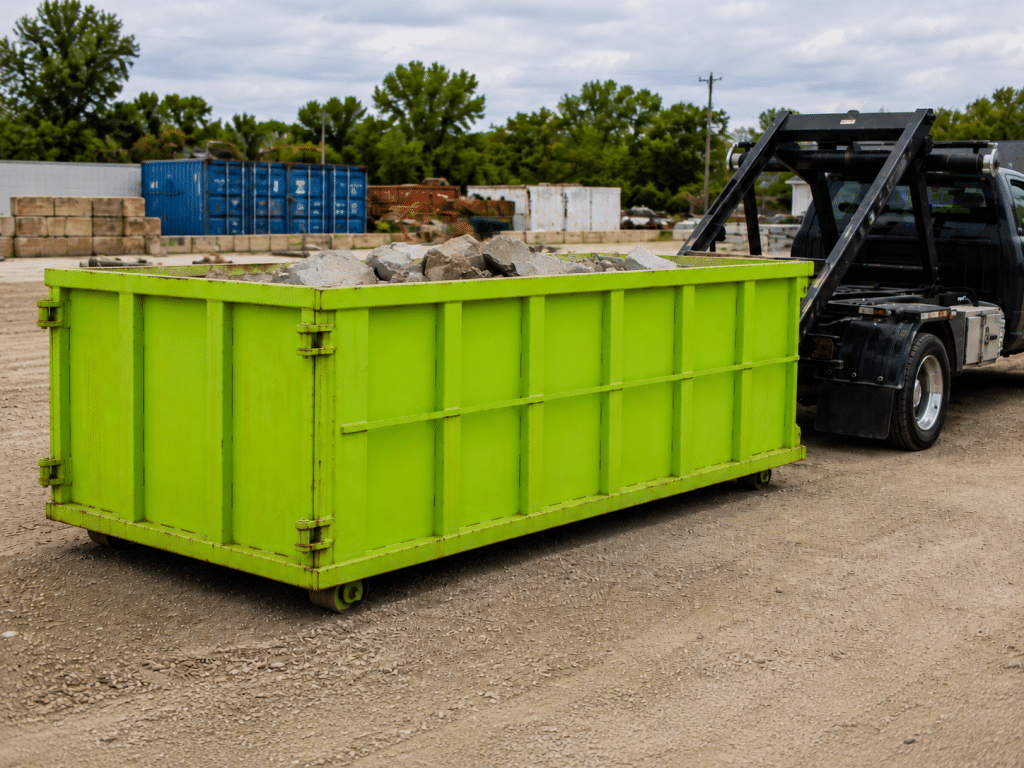
Pack Mule’s concrete dumpster rental option lists a low-sided container measuring 22 feet long, 7 feet wide, and 3 feet high. The dedicated page advertises one-, three-, and seven-day options; confirm current availability and terms.
Ask for the approved concrete load, any fill-height restriction, and instructions for distributing material. Do not assume the entire container can be filled simply because it is labeled 15 yards.
Estimate Slab Weight Before Demolition
A useful estimate starts with the intact slab’s area and thickness.
The U.S. Bureau of Reclamation’s concrete properties guidance describes conventional concrete with small aggregate as generally near 145 pounds per cubic foot, with density varying by concrete type and reinforcement. The example below uses 145 pounds per cubic foot as an explicit planning assumption.
Hypothetical Example: A 10-by-12-Foot Patio
Assume a uniform, unreinforced slab that is 4 inches thick:
Step | Calculation | Estimated result |
Area | 10 feet × 12 feet | 120 square feet |
Thickness in feet | 4 ÷ 12 | ⅓ foot |
Solid concrete volume | 120 × ⅓ | 40 cubic feet |
Solid volume in cubic yards | 40 ÷ 27 | About 1.48 cubic yards |
Estimated concrete weight | 40 × 145 | 5,800 pounds |
Weight in U.S. short tons | 5,800 ÷ 2,000 | 2.9 tons |
This estimates concrete only. It excludes reinforcing steel, attached dirt, other materials, and thicker sections. Actual density and dimensions may differ.
If the same slab were uniformly 6 inches thick, its concrete volume and estimated weight would be 50% greater. Thickness is worth checking.
Broken Concrete Takes Up Space Differently
Breaking the slab creates irregular pieces with gaps between them. The loose pile can therefore occupy more space than the original solid slab volume.
Do not multiply the loose pile’s entire volume by solid concrete density: that would count air gaps as concrete. Likewise, do not assume the estimated 1.48 solid cubic yards tells you exactly how much dumpster space the broken pieces will occupy.
Share the estimate with Pack Mule. It is planning information, not permission to load 5,800 pounds.
Confirm What “Clean Concrete” Means for Your Order
Material separation can affect both acceptance and pricing. Pack Mule’s concrete page warns of additional charges when loads contain trash, dirt, or other debris.
Its heavy-debris page describes several masonry materials and says rebar must be cut into sections shorter than 4 feet. However, those statements do not establish that every listed material can be combined under a clean-concrete rate.
Before booking, confirm:
- Whether brick, block, asphalt, or stone can accompany the concrete.
- Whether attached dirt must be removed.
- Whether reinforced concrete and wire mesh are accepted.
- How rebar must be prepared for your load.
- Whether coatings or other contamination change acceptance.
- Whether mixed demolition debris needs a separate arrangement.
Then review Pack Mule’s dumpster rental pricing and request the terms that apply to your actual material list.
Plan Placement, Loading, and Pickup Together
Choose a proposed location that works for both the delivery truck and the loading method. Tell Pack Mule about slopes, narrow access, surface conditions, and nearby obstructions.
The listed container dimensions do not establish truck clearance or guarantee that a driveway is suitable. Ask the team to assess access and discuss surface concerns.
Confirm how pieces should be placed, any maximum piece size, and the agreed stopping point for loading. Keep additional debris separate if the estimate changes instead of continuing because space remains.
Arrange delivery around the demolition schedule and equipment availability. Confirm pickup procedures, rental end dates, and options for additional hauls before work begins.
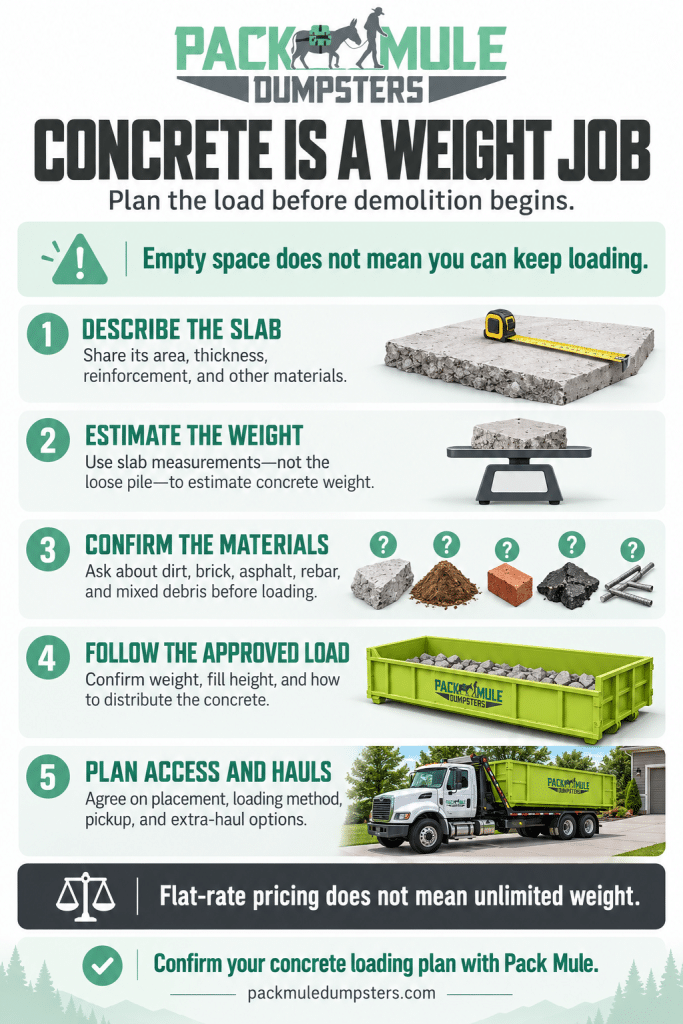
How an Underestimated Slab Can Stall the Job
Imagine planning a patio removal around a thickness estimate that misses a heavier section. More concrete comes out than expected.
If loading continues beyond the approved limit, the load may need correction. If loading stops, the remaining rubble needs a staging or hauling plan. Either way, the original schedule changes.
Mixing unapproved materials into the container can create another task: separating debris or arranging different disposal. Blocked pickup access can add further delay.
Contact Pack Mule when conditions differ from your estimate. Confirm the next load or rental change before the problem grows.
Prepare Your Concrete Removal With Pack Mule
Pack Mule Dumpsters offers concrete and heavy-debris rental services across Dayton, Cincinnati, Springfield, and surrounding served communities. Before demolition:
- Record the slab’s area and known thickness.
- Identify reinforcement and other materials.
- Share an estimated concrete volume and weight.
- Confirm the container, accepted materials, price, and loading limit.
- Agree on placement and the loading method.
- Confirm delivery, pickup, and additional-haul options.
Contact Pack Mule to confirm your concrete loading plan before scheduling the tear-out.
- Key Takeaway
- Plan concrete removal around weight, material acceptance, and the approved haul.
- Estimate the slab before demolition, but expect broken pieces to occupy space differently.
- Confirm loading instructions and additional-haul options with Pack Mule before filling the container.
Frequently Asked Questions
Can concrete go in a regular dumpster?
Do not assume a standard construction dumpster rental covers concrete. Tell Pack Mule about the material first so the team can confirm the appropriate container and loading arrangement.
How much does a 4-inch concrete slab weigh?
Using 145 pounds per cubic foot, a uniform 4-inch slab weighs approximately 48.3 pounds per square foot before accounting for reinforcement or attached material. Actual weight depends on thickness, density, and other components.
Can I fill a concrete dumpster to the top?
Only load to the limit Pack Mule approves for your order. Visible space and flat-rate pricing do not establish an allowable concrete load.
Can I mix concrete with dirt, brick, or asphalt?
Confirm each material and whether it may be mixed under your rental terms. A material accepted through one service is not automatically permitted in a clean-concrete load.
What if I have more concrete than expected?
Contact Pack Mule before exceeding the agreed loading limit. Ask about another haul or container and confirm the cost and scheduling options.
References
- U.S. Bureau of Reclamation: Concrete Properties Considerations, Section E-1.4 — Supports the density assumption and explains variation with concrete type and reinforcement. The patio calculations are illustrative arithmetic using that assumption.